前言
本文主要讲解 BFS 是什么,以及最最最简单的模板题的题解。不讲非模板题,因为我不会。
想要让自己变成脑雾的了解 BFS 官方解释的可以去阅读 OIwiki 的 BFS 讲解
1 模板介绍
BFS 思路:将有可能的情况(如在最短路题目中可以走的地点等)加入队列等待处理,在下一个 循环 / 递归 中处理。
适用于:求最短路的成本(距离/时间/花费)、找联通快
Q:为什么用队列?
A:队列先进先出,所以当你第一次到达终点的时候就肯定是最短的路线,可以用来找最短路。
2 最短路
个人认为最短路是 BFS 最常考的考法,可能是因为我做的少罢。
2.1 一维最短路
一维最短路例题 P1135 奇怪的电梯。
思路:
BFS 暴如力,将可以到达的层数加入队列 q,当当前层数是目标层数时,就找到了到达目标层数的最短路,这时候输出 top.step(目前的步数)就是正确答案。因为队列先进先出,所以当你第一次到达终点(目标层数)的时候就肯定是最短的路线。
如果把所有能去的层数都去了(q.size() == 0)还没到,那就到不了力!(悲)所以我们在到达的时候就把拿来判断是否达到过的 bool 变量 $ans$ 设为 false,这样就可以在结束的时候通过判断 $ans$ 是 true 还是 false 来知道有没有到达目标层数。
呆马:
1
2
3
4
5
6
7
8
9
10
11
12
13
14
15
16
17
18
19
20
21
22
23
24
25
26
27
28
29
30
31
32
33
34
35
36
37
38
39
40
41
42
43
44
45
46
47
48
49
50
51
52
| #include <bits/stdc++.h>
using namespace std;
const int N = 2e2 + 10;
struct lift
{
int sit, step;
};
int n, a, b, k[N];
bool v[N], ans = true;
queue <lift> q;
void bfs(int x, int s)
{
q.push( {x, s} );
v[x] = true;
while (q.size())
{
lift top = q.front();
q.pop();
if (top.sit == b)
{
cout << top.step;
ans = false;
return ;
}
if ((top.sit + k[top.sit]) <= n and !v[top.sit + k[top.sit]])
{
v[top.sit + k[top.sit]] = true;
q.push( {top.sit + k[top.sit], top.step + 1} );
}
if ((top.sit - k[top.sit]) >= 1 and !v[top.sit - k[top.sit]])
{
v[top.sit - k[top.sit]] = true;
q.push( {top.sit - k[top.sit], top.step + 1} );
}
}
}
int main()
{
cin >> n >> a >> b;
for (int i = 1; i <= n; i++)
cin >> k[i];
bfs(a, 0);
if (ans)
cout << -1;
return 0;
}
|
2.2 二维最短路
二维最短路例题:P1825 [USACO11OPEN] Corn Maze S
思路
和一维最短路的差不多,像啊很像啊,只不过从 $sit$ 变成 $x$ 和 $y$。
只不过里面的司马滑梯很恶心人,但是想到正解之后就明了了很多,这里就不放死法了。
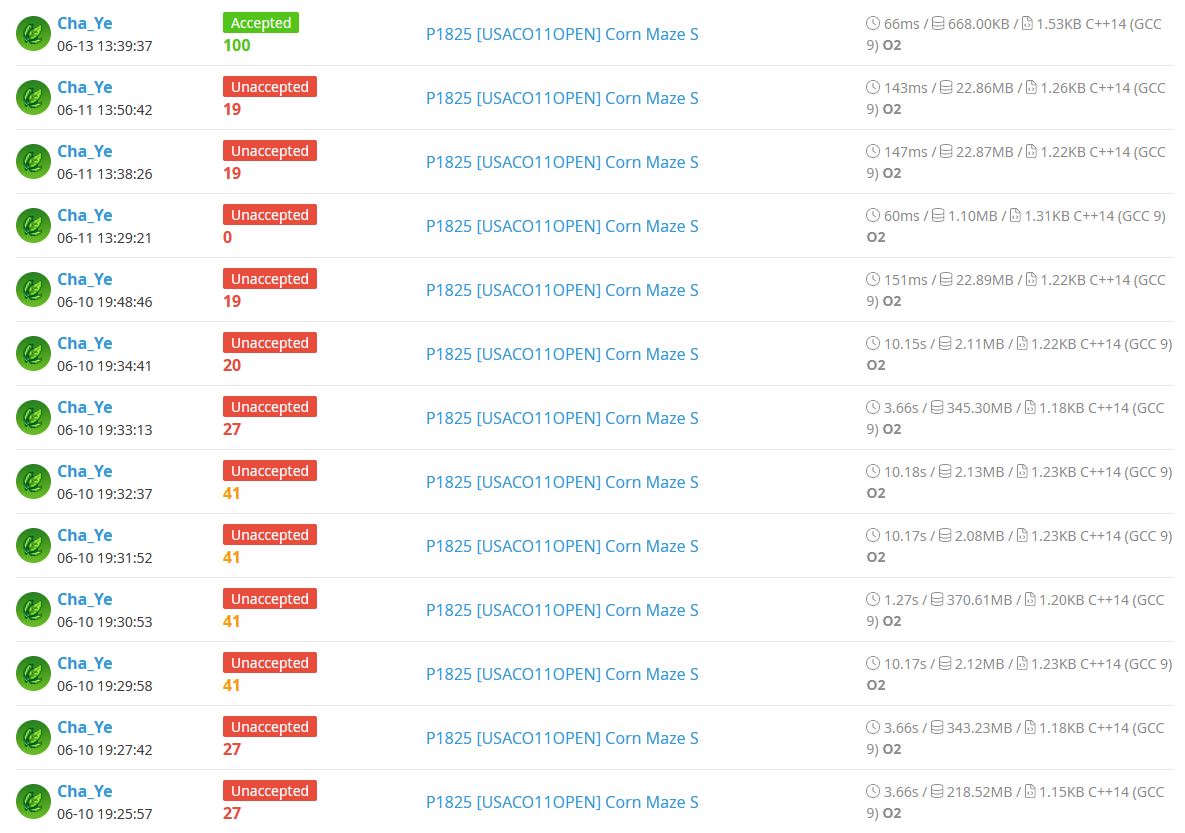
滑梯的解决方法:用两个数组把每个滑梯的起点 $x$ $y$ 和终点 $x$ $y$ 存下,然后等到达滑梯口的时候直接查询并传送就好了,如果滑梯有 CD 将会更恶心。
贷蚂
1
2
3
4
5
6
7
8
9
10
11
12
13
14
15
16
17
18
19
20
21
22
23
24
25
26
27
28
29
30
31
32
33
34
35
36
37
38
39
40
41
42
43
44
45
46
47
48
49
50
51
52
53
54
55
56
57
58
59
60
61
62
63
64
65
66
67
68
69
70
71
72
73
74
75
76
77
78
79
80
81
82
83
84
85
86
87
88
89
| #include <bits/stdc++.h>
#define int long long
using namespace std;
const int N = 3e2 + 10, INF = 0x3f3f3f3f;
const int dx[4] = {1, -1, 0, 0};
const int dy[4] = {0, 0, 1, -1};
struct sit
{
int x, y, step;
};
struct tpsit
{
int x, y;
};
int n, m, sx, sy, ex, ey, ans = INF;
char c, a[N][N];
bool v[N][N];
tpsit tps[N], tpe[N];
queue <sit> q;
void bfs(int sx, int sy)
{
q.push( {sx, sy, 0} );
while (q.size())
{
sit top = q.front();
q.pop();
if (top.x == ex and top.y == ey)
{
cout << top.step;
return ;
}
if (a[top.x][top.y] >= 'A' and a[top.x][top.y] <= 'Z')
{
char t = a[top.x][top.y];
if (top.x == tps[(int)t].x and top.y == tps[(int)t].y)
top.x = tpe[(int)t].x, top.y = tpe[(int)t].y;
else
top.x = tps[(int)t].x, top.y = tps[(int)t].y;
}
for (int k = 0; k < 4; k++)
{
int xx = top.x + dx[k];
int yy = top.y + dy[k];
if (xx >= 1 and xx <= n and yy >= 1 and yy <= m and v[xx][yy] )
{
v[xx][yy] = false;
q.push( {xx, yy, top.step + 1} );
}
}
}
}
signed main()
{
cin >> n >> m;
for (int i = 1; i <= n; i++)
for (int j = 1; j <= m; j++)
{
cin >> c;
a[i][j] = c;
if (c == '@')
sx = i, sy = j, v[i][j] = false;
else if (c == '=')
ex = i, ey = j, v[i][j] = true;
else if (c == '#')
v[i][j] = false;
else if (c == '.')
v[i][j] = true;
else
{
v[i][j] = true;
if(tps[(int)c].x and tps[(int)c].y)
tpe[(int)c].x = i, tpe[(int)c].y = j;
else
tps[(int)c].x = i, tps[(int)c].y = j;
}
}
bfs(sx, sy);
return 0;
}
|
3 连通块
连通块经典例题:P1451 求细胞数量
思路
找到数字的时候直接开始 BFS!
BFS:把也是数字的地方的坐标塞进队列,并把它变成 0,这样就不会重复搜到了。一个 BFS 下来所有连通的是数字的地方就都变成 0 了,所以主函数中的 for 中找到了几次数字就有几个细胞。
好像说的不是很像人话。。。
直接看代码吧
逮玛
1
2
3
4
5
6
7
8
9
10
11
12
13
14
15
16
17
18
19
20
21
22
23
24
25
26
27
28
29
30
31
32
33
34
35
36
37
38
39
40
41
42
43
44
45
46
47
48
49
50
51
52
53
54
55
56
57
58
59
60
61
62
63
64
65
66
67
68
69
70
71
72
| #include <bits/stdc++.h>
using namespace std;
const int N = 1e2 + 10;
struct node
{
int x, y;
};
int n, m, a[N][N], ans;
bool v[N][N];
int dx[4] = {1, -1, 0, 0};
int dy[4] = {0, 0, 1, -1};
queue <node> q;
bool check(int x, int y)
{
if (x >= 1 and x <= n and y >= 1 and y <= m and !v[x][y])
return true;
else
return false;
}
void bfs(int x, int y)
{
q.push( {x, y} );
v[x][y] = true;
while (q.size())
{
node top = q.front();
a[top.x][top.y] = 0;
v[top.x][top.y] = false;
q.pop();
for (int i = 0; i < 4; i++)
{
int xx = top.x + dx[i];
int yy = top.y + dy[i];
if (a[xx][yy] != 0 and !v[xx][yy])
{
q.push( {xx, yy} );
v[xx][yy] = true;
}
}
}
}
int main()
{
cin >> n >> m;
for (int i = 1; i <= n; i++)
for (int j = 1; j <= m; j++)
{
char c;
cin >> c;
a[i][j] = c - 48;
}
for (int i = 1; i <= n; i++)
for (int j = 1; j <= m; j++)
{
if (a[i][j] != 0)
{
ans++;
bfs(i, j);
memset(v, false, sizeof(v));
}
}
cout << ans;
return 0;
}
|
4 后记
我是蒟蒻,只要是非模板的都不会(有些模板也不会。
既然如此只好开始怒切 BFS 水题了!!!